
Basilica di Santa Croce
.jpg?width=1200)
General Information
Denomination
Catholic
Address
16 Piazza Santa Croce
Firenze, Toscana, Italia
Location
Find the approximate location of Basilica di Santa Croce
Location data: © OpenStreetMap contributors via LocationIQ | Visualization: Google Maps
How to Get There
Address: 16 Piazza Santa Croce Firenze, Toscana, Italia
About Basilica di Santa Croce
📜 History
The construction of the basilica began on May 12, 1294, possibly under the direction of the architect Arnolfo di Cambio, commissioned by the Order of Friars Minor Franciscans. The works were sponsored by the wealthiest families of Florence and concluded in 1385. Pope Eugenius IV consecrated the temple in 1442. Throughout the 14th century, the Peruzzi, Bardi, and Baroncelli families financed side chapels decorated with frescoes, contributing to the artistic enrichment of the complex. During the Counter-Reformation, in 1560, Giorgio Vasari supervised an interior reconstruction that removed the choir screen and caused damage to several pictorial cycles. After Italian unification, the monastic complex became public property in 1866. In November 1966, the flooding of the Arno River inundated the basilica and caused serious damage to works of art and the architectural structure, including the crucifix by Cimabue. Restoration work lasted for decades and continues today with the support of Italian civil protection agencies.
🏛️ Architecture
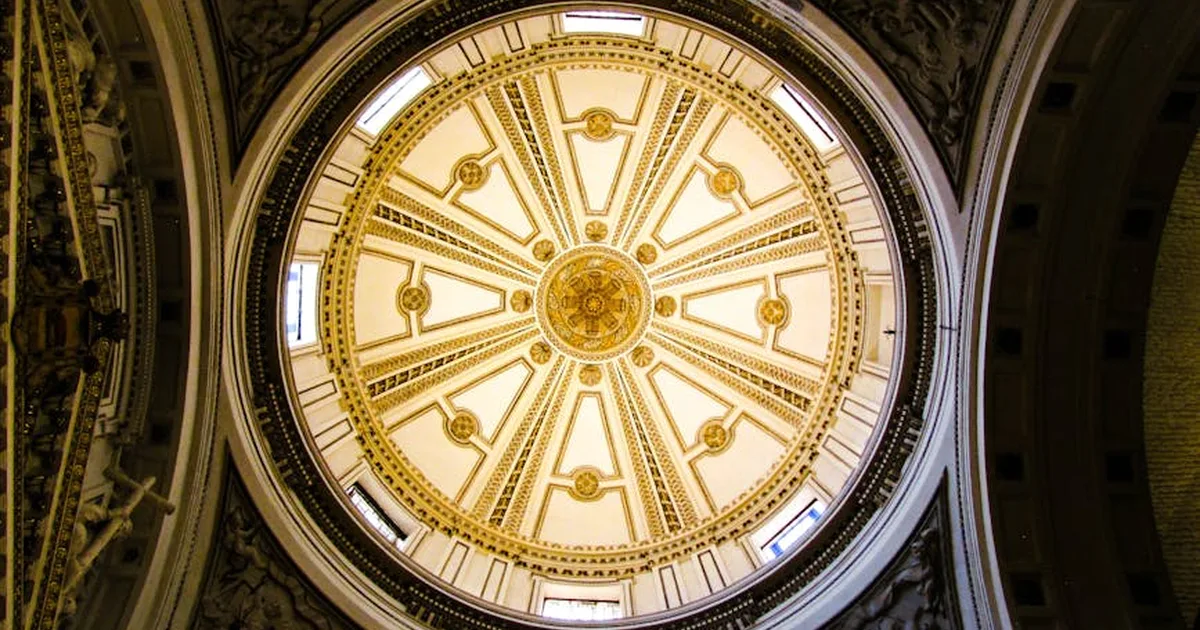
The basilica features a floor plan in the shape of an Egyptian or tau cross, with a length of 115 meters, making it the largest Franciscan church in the world. The style is fundamentally Gothic, with Renaissance additions incorporated in later centuries. The central nave is flanked by two side aisles separated by octagonal columns, and the interior houses sixteen chapels decorated with frescoes from the 13th to the 15th centuries. The exterior facade, in neogothic marble, was designed by Niccolò Matas and executed between 1857 and 1863. The bell tower dates from 1842, the year it replaced a previous one damaged by lightning. The first cloister connects to the Cappella dei Pazzi, attributed to Filippo Brunelleschi and completed in the 1470s; the second cloister was finished by the same architect in 1453. Inside, the frescoes by Giotto in the Peruzzi and Bardi chapels stand out, as do those by Agnolo Gaddi in the presbytery—executed between 1385 and 1387—and those by Taddeo Gaddi in the Baroncelli chapel. Among the sculptures are the Cavalcanti Annunciation by Donatello and the crucifix by Cimabue, severely damaged in the 1966 flood.
⭐ Key Facts
Known as the Temple of the Italian Glories, the church houses the tombs and monuments of figures from Italian science, letters, and arts. Here rest the remains of Michelangelo, with a funerary monument executed by Giorgio Vasari; of Galileo Galilei; of Niccolò Machiavelli, whose monument was designed by Innocenzo Spinazzi in 1787; of the poet Ugo Foscolo; and of the composer Gioacchino Rossini. A cenotaph erected in 1829 honors the memory of Dante Alighieri, whose remains are preserved in Ravenna. The basilica belongs to the Catholic Archdiocese of Florence and is administered by the Order of Friars Minor. Its complex includes the Museo dell'Opera di Santa Croce, located in the former refectory, and the Scuola del Cuoio, a leather craft workshop operating in the former Franciscan dormitory. The historic center of Florence, of which this complex is a part, was inscribed on the UNESCO World Heritage List in 1982.
The Basilica di Santa Croce concentrates centuries of artistic, religious, and intellectual history in a single space. Its naves safeguard the tombs of scientists, writers, and artists who marked the course of Western civilization, while its chapels preserve frescoes representing decisive moments in Italian medieval painting. The complex also includes peaceful cloisters and the Cappella dei Pazzi, a representative example of Florentine Renaissance architecture. A visit to the complex offers a journey through all of this in the heart of Florence.
✍️ Curated by Thomas Anderson
·
Last updated:
Information verified by the EncuentraIglesias editorial team
📚 Readings to strengthen your faith
Articles from the Faith & Life blog selected for this community
Did you notice something incorrect?😯
We apologize 🙏. Being the most complete church directory in the world requires a lot of time and effort... and only God is perfect 😄! We would greatly appreciate it if you help us with your suggestions to keep the information verified and reliable.
You can send us your observations, suggest corrections or even request that we remove this record if you consider it does not correspond to a church.
Suggest an edit