
Basilica di San Pietro in Vaticano

General Information
Denomination
Catholic
Address
St. Stephen's Square
Roma, Lazio, Italia
C.P. 00120
Location
Find the approximate location of Basilica di San Pietro in Vaticano
Location data: © OpenStreetMap contributors via LocationIQ | Visualization: Google Maps
How to Get There
Address: St. Stephen's Square Roma, Lazio, Italia
About Basilica di San Pietro in Vaticano
📜 History
The Basilica of San Pietro stands on the site where the apostle Peter was martyred in 64 AD, under the reign of Emperor Nero. Constantine I ordered the construction of the first basilica on that site, whose construction spanned between 326 and 356 AD. More than a millennium later, Pope Julius II ordered the demolition of that building to erect one of larger proportions. On April 18, 1506, the first stone of the new temple was laid, a project that took 120 years and was under the supervision of thirteen successive pontiffs. Donato Bramante developed the original design with a Greek cross plan; upon his death, the direction of the works passed to Raphael Sanzio, then to Antonio da Sangallo the Younger, and finally to Michelangelo, who resumed the Greek cross plan and designed the central dome. Carlo Maderno extended the main nave and designed the current facade. On November 18, 1626, Pope Urban VIII consecrated the temple. Between 1939 and 1949, archaeological excavations commissioned by Pope Pius XII confirmed the presence of the apostle's remains beneath the main altar. The basilica hosted the sessions of the Second Vatican Council between 1962 and 1965.
🏛️ Architecture
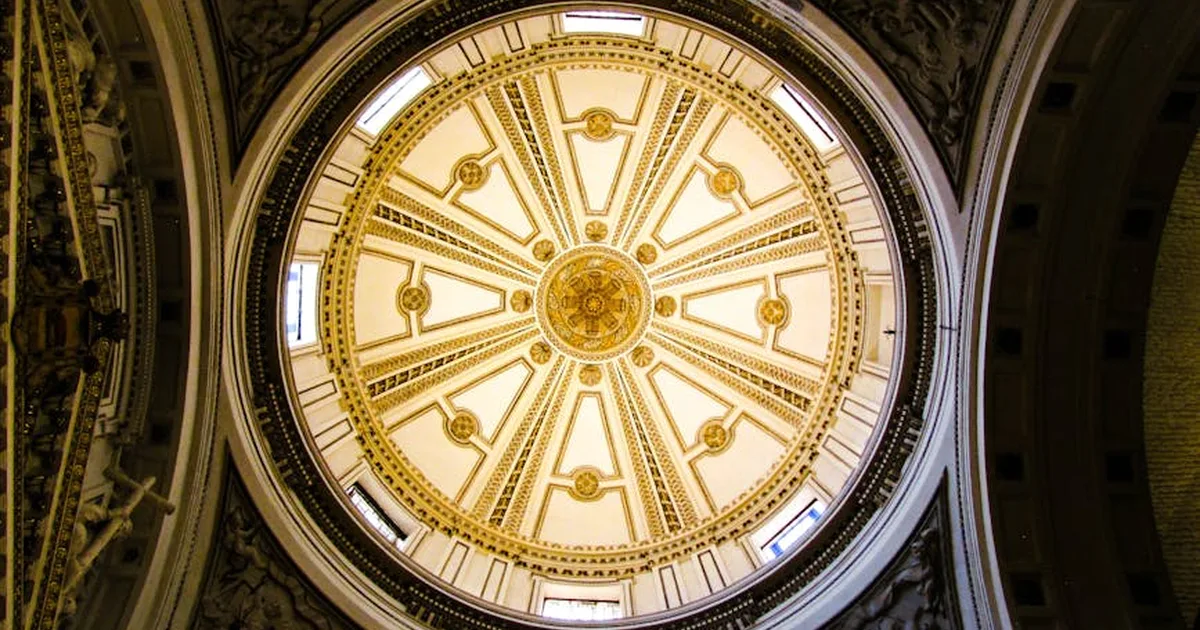
The basilica combines Renaissance style with Baroque elements in a monumental ensemble. It has a total length of 218 meters and covers an area of 23,000 square meters. The facade, designed by Carlo Maderno, measures 115 meters wide and 46 meters high, and is topped by thirteen statues of 5.7 meters representing Christ, John the Baptist, and ten apostles. The dome was designed by Michelangelo but completed in 1590 by Domenico Fontana and Giacomo della Porta, twenty-four years after the artist's death; it reaches a height of 136.57 meters and has an interior diameter of 41.47 meters. The exterior is clad in travertine, while the interior houses more than 10,000 square meters of marble mosaics. The enclosure has 45 altars, 11 chapels, and five access doors with different sculptural programs. At the center of the main nave is the bronze baldachin designed by Gian Lorenzo Bernini, built with metal from the Pantheon of Agrippa and supported by four spiral columns, located directly above the apostle's tomb. Bernini was also responsible for designing the exterior square with its two semicircular colonnades.
⭐ Key Facts
The Basilica of San Pietro is one of the four major basilicas of Rome and the main ceremonial center of Catholicism. It is not technically a cathedral—that rank belongs to San Giovanni in Laterano—but it is the seat of the main papal celebrations, including canonizations, solemn masses, and the funerals of popes. It was inscribed on the UNESCO World Heritage List in 1984, as part of Vatican City, under cultural criteria ii, iii, iv, and v. Inside, Michelangelo's Pietà is preserved, one of the best-known works of the Renaissance, along with the mosaics covering altars and the dome. The excavations carried out between 1939 and 1949 confirmed that beneath the main altar are the remains of the apostle Peter, a central element for the Catholic doctrine of apostolic succession. The six bells of the temple ring together on the feasts of Easter, Christmas, Epiphany, Pentecost, and June 29, the solemnity of Saints Peter and Paul. Access to the interior is free, allowing millions of pilgrims and visitors from all continents to arrive each year.
The Basilica of San Pietro receives visitors from all over the world free of charge, making it one of the most accessible monuments in Europe. Within its naves coexist the history of the first century of Christianity, represented by the apostle's tomb, and the art of the 16th and 17th centuries present in each chapel, altar, and mosaic. Those wishing to delve deeper into its history can descend to the Vatican Grottoes, where the remains of numerous pontiffs rest, or ascend to the dome to contemplate Rome from above.
✍️ Curated by Thomas Anderson
·
Last updated:
Information verified by the EncuentraIglesias editorial team
📚 Readings to strengthen your faith
Articles from the Faith & Life blog selected for this community
Did you notice something incorrect?😯
We apologize 🙏. Being the most complete church directory in the world requires a lot of time and effort... and only God is perfect 😄! We would greatly appreciate it if you help us with your suggestions to keep the information verified and reliable.
You can send us your observations, suggest corrections or even request that we remove this record if you consider it does not correspond to a church.
Suggest an edit