
For decades, many have assumed that science and faith are locked in an endless conflict. Yet as scientific discovery advances, this narrative is increasingly challenged. The more we learn about the universe, the more it points toward a mind behind it all. Far from being an enemy of belief, unbiased scientific inquiry often leads us to consider the divine.
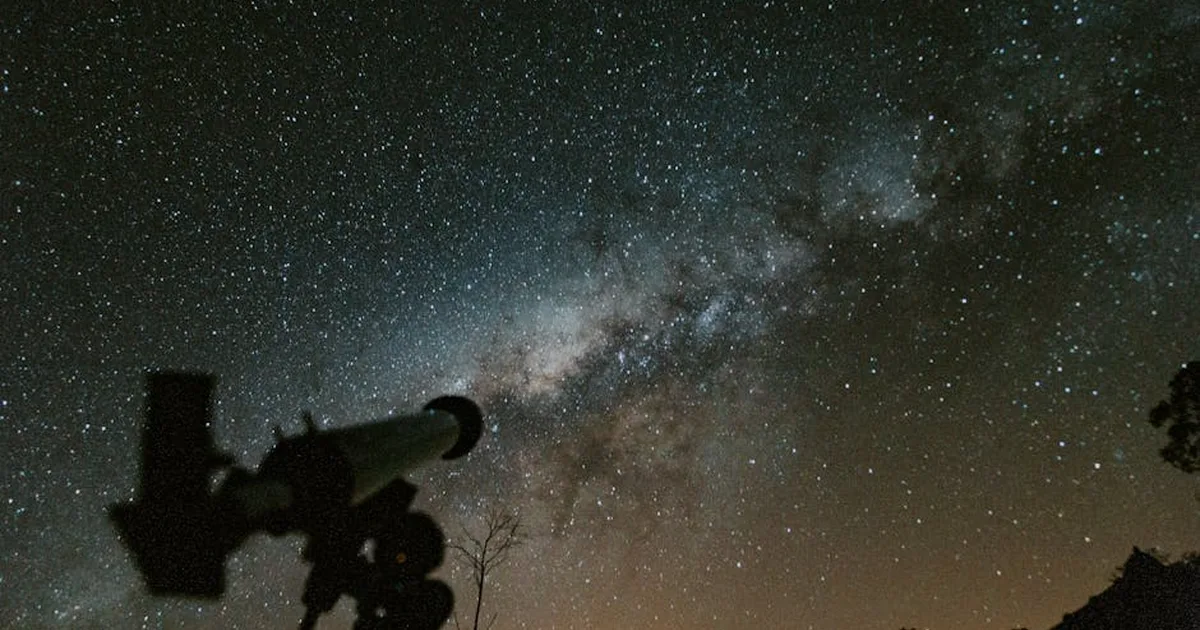
Christians need not fear science. Instead, we can embrace it as a tool that reveals the order, complexity, and contingency of creation. As the psalmist wrote, “The heavens declare the glory of God, and the sky above proclaims his handiwork” (Psalm 19:1, ESV). Modern cosmology only deepens that proclamation.
“For his invisible attributes, namely, his eternal power and divine nature, have been clearly perceived, ever since the creation of the world, in the things that have been made.” — Romans 1:20 (ESV)
The Universe Had a Beginning
One of the most startling discoveries of 20th-century cosmology is that the universe is not eternal. It had a beginning. The Big Bang theory, once resisted by some scientists for its theological implications, is now virtually undisputed. But if the universe began to exist, it requires a cause—something outside of space and time that brought it into being.
Philosophers and physicists alike have noted that this points toward a transcendent Creator. As the Bible states, “In the beginning, God created the heavens and the earth” (Genesis 1:1, NIV). Scientific evidence for a beginning aligns remarkably with this ancient claim.
Consider the second law of thermodynamics: the universe is running down, like a clock winding down. If it were infinitely old, it would have already reached a state of maximum entropy. The fact that it hasn’t implies a finite past. This is just one of many lines of evidence that converge on a cosmic beginning.
Fine-Tuning: The Universe Seems Designed for Life
Beyond the universe’s beginning, scientists have discovered that the fundamental constants of physics are exquisitely balanced to allow life. If the force of gravity were slightly stronger or weaker, stars could not form. If the cosmological constant were a tiny fraction different, the universe would have collapsed or expanded too rapidly for galaxies to emerge. The list goes on.
This “fine-tuning” is so precise that many physicists, even those who are not religious, acknowledge it looks like design. As one scientist put it, “The universe appears to have been tailor-made for us.” This resonates with the biblical view that God created a world intended for human habitation and relationship.
“For thus says the Lord, who created the heavens (he is God!), who formed the earth and made it (he established it; he did not create it empty, he formed it to be inhabited!).” — Isaiah 45:18 (ESV)
The fine-tuning argument does not prove God beyond all doubt, but it provides strong circumstantial evidence. It invites us to ask: Is it more reasonable to believe that this intricate balance happened by chance, or that an intelligent Creator set the dials?
DNA and the Language of Life
Perhaps the most compelling evidence for a Creator comes from biology itself. The discovery of DNA revealed a digital code stored in every living cell—a language of four letters that instructs the machinery of life. Information of this kind always comes from a mind. No known natural process produces complex, specified information.
As biochemist Michael Behe has argued, certain molecular machines in the cell are “irreducibly complex”—they require all their parts to function, and could not have evolved step by step. This suggests purposeful design. The Bible affirms that God is the author of life: “For you formed my inward parts; you knitted me together in my mother’s womb” (Psalm 139:13, ESV).
Practical Reflection: Letting Wonder Lead to Worship
Science can be a pathway to deeper faith if we allow it. The next time you look at the night sky or read about a new discovery, pause and marvel. Let the evidence of order and purpose stir your heart toward the Creator. Consider keeping a journal of scientific facts that inspire awe, and use them as prompts for prayer or gratitude.
Ask yourself: Have I been influenced by the false narrative that science and faith are enemies? How can I embrace the truth that all truth is God’s truth? Whether in a laboratory or a church pew, we can worship the same God who is the source of all wisdom.





Comments