
At the heart of many Christian communities, there exists a liturgical object that transcends its material function to become a window to the divine. Commonly known as a monstrance or ostensorium, this sacred vessel has a profoundly spiritual purpose: to display the consecrated host for the adoration of the faithful. It is not merely a piece of metalwork, however beautiful, but an instrument that facilitates a personal and communal encounter with a central truth of our faith.
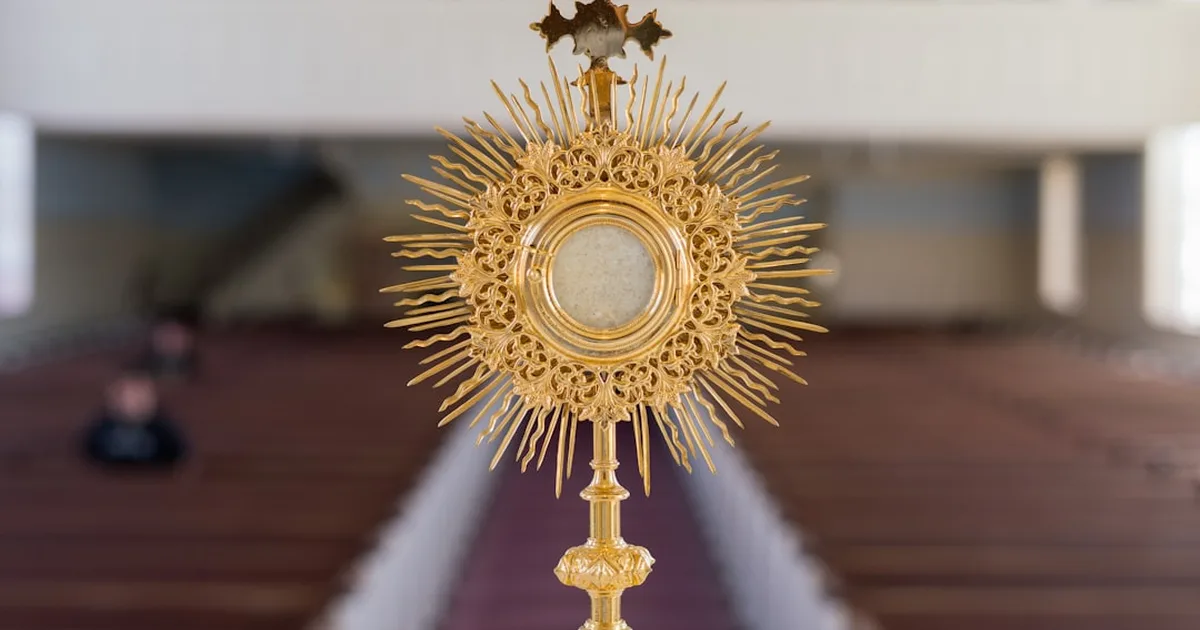
The monstrance invites us to pause, to contemplate, and to recognize the real presence of Jesus Christ in the Eucharistic bread. In a world full of distractions, this object points us toward what is essential, reminding us of Jesus' words: "I am the bread of life. Whoever comes to me will never go hungry, and whoever believes in me will never be thirsty" (John 6:35, NIV). It is a tangible symbol of an eternal promise.
The Deep Meaning of Eucharistic Exposition
Why expose the Blessed Sacrament? This practice, rooted in Christian tradition, responds to a fundamental human longing: to see in order to believe, to contemplate in order to love. The monstrance makes the invisible visible, allowing our senses to participate in the act of faith. We do not worship the object itself, but the One it points to and contains. It is an act of humility that acknowledges our need for concrete signs on our spiritual journey.
Eucharistic exposition using the monstrance occurs primarily in three significant contexts. First, during Eucharistic adoration, where the community gathers in silent or sung prayer before the presence of Christ. Second, during Benediction with the Blessed Sacrament, when the minister blesses the assembly with the monstrance. And third, in Eucharistic processions, especially during the solemnity of Corpus Christi, where faith takes to the streets in a public testimony of love for the Sacrament.
An Important Distinction
It is valuable to distinguish the monstrance from other sacred vessels. While the ciborium or pyx is designed to store and transport consecrated hosts, the monstrance has the specific purpose of displaying them for veneration. This functional difference underscores the contemplative and devotional nature of the ostensorium. One preserves, the other reveals; both serve the same mystery from complementary angles.
Parts and Symbols of the Monstrance
Although designs vary according to traditions and the creativity of artists, the monstrance generally features common elements full of meaning. At the center, a piece of transparent glass, called the luna or lunette, protects and allows viewing of the consecrated host. This glass symbolizes the purity and transparency of faith needed to recognize Christ.
Surrounding this center, we often find rays of precious metal extending like a radiant sun. These rays represent the light of Christ that illuminates the world, reminding us that Jesus said, "I am the light of the world. Whoever follows me will never walk in darkness, but will have the light of life" (John 8:12, NIV). The firm base on which the entire structure rests speaks of the stability of our faith, founded on the rock that is Christ.
Many monstrances also incorporate Eucharistic symbols such as sheaves of wheat and clusters of grapes, which directly refer us to the elements of bread and wine. Other designs include images of adoring angels, reflecting the heavenly worship that joins with ours. Every detail, when well conceived, seeks to elevate the mind and heart toward God.
The Monstrance in the Life of the Church Today
In our time, marked by the pontificate of Pope Leo XIV, who continues to inspire the Church with a pastoral spirit, Eucharistic devotion remains fully relevant. The monstrance is not a relic of the past, but a living sign that invites us to a deeper encounter. In a digital and often fragmented age, the simple act of gazing upon the host in the monstrance can be a powerful antidote to dispersion, anchoring us in the one thing necessary.
Pope Leo XIV, following the pastoral path of his predecessors, has encouraged a renewed love for the Eucharist. The monstrance, in this context, becomes a school of prayer and presence. It teaches us to be still, to adore, and to allow ourselves to be transformed by the gaze of Christ, who looks upon us with infinite mercy from the humble piece of bread.
May this reflection help us appreciate the monstrance not as a mere object, but as a companion on our journey of faith, a silent preacher that constantly reminds us: "Here is God with us. Here is love made visible. Come, adore, and be renewed."





Comments