
During Milan Design Week, St. Ambrose Basilica opens its doors, offering a unique experience that unites art, history, and spirituality. The "Ambrosius. The Basilica's Treasure" initiative represents a precious opportunity to rediscover places of extraordinary value, usually inaccessible to the public. In an era where daily frenzy often distances us from our inner dimension, this extraordinary opening invites us to pause, contemplate, and nourish our soul through beauty that speaks of God. As the psalmist writes: "One thing I ask from the Lord, this only do I seek: that I may dwell in the house of the Lord all the days of my life, to gaze on the beauty of the Lord" (Psalm 27:4 NIV).
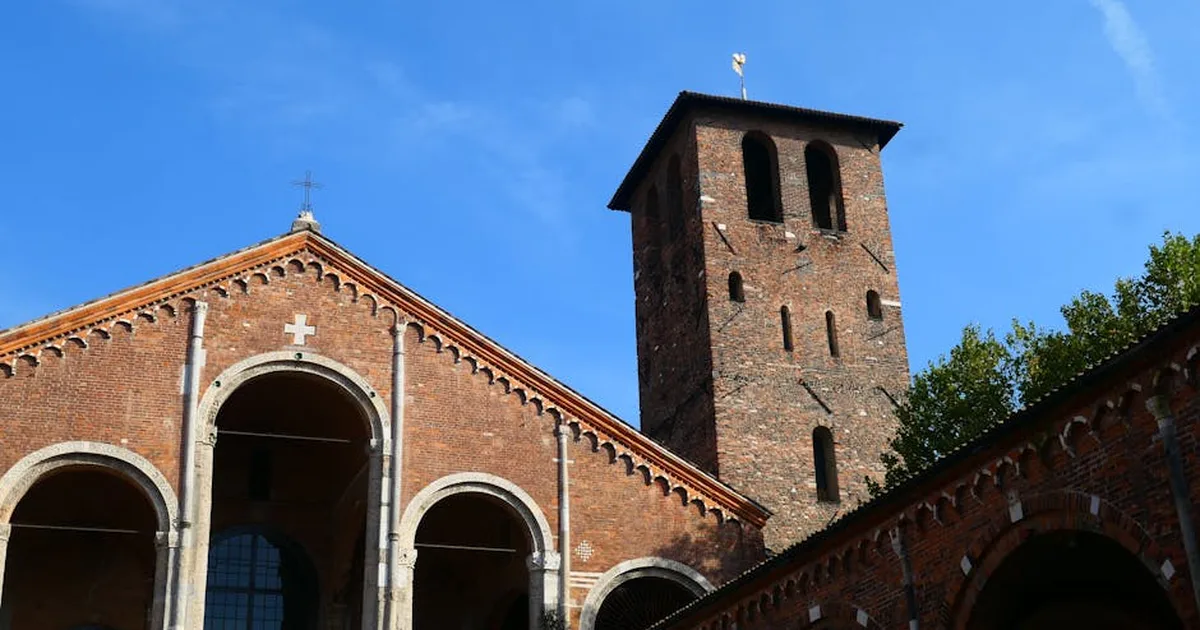
The Oratory of the Passion: A Space for Prayer and Art
Built in 1477 for the confraternity of Santa Maria della Passione, the Oratory of the Passion presents itself as an architectural and spiritual jewel. This place, adjacent to the Canons' Bell Tower, was conceived as a center of spiritual life, where the faithful could gather in prayer and meditate on Christ's passion. The frescoes, attributed to the school of Bernardino Luini, preserve their expressive power intact, telling through sacred images the mystery of redemption. Visiting this oratory means entering into dialogue with the faith of those who preceded us, discovering how art can become prayer and how prayer can inspire art.
The Restoration: A Bridge Between Past and Present
The recent restoration, curated by cabinetmaker and designer Giuseppe Amato in dialogue with architect Giorgio Ripa, represents a respectful and enlightened intervention. Using traditional materials like wood, iron, lime, and natural pigments, worked according to ancient techniques, the project has managed to create a harmonious continuity between history and contemporaneity. This approach reminds us that faith is not a heritage to be preserved statically, but a living reality that incarnates itself in every age, dialoguing with the present without betraying its roots.
The Canons' Cloister: A Garden for the Soul
Next to the Oratory of the Passion, the Canons' Cloister offers itself as a space for contemplation and relationship, where nature becomes a teacher of spirituality. Cared for by horticulturist Elisabetta Cavigioli and biologist Angela Ronchi, the cloister hosts the Hortus simplicium, dedicated to medicinal and healing herbs. This garden, inspired by ancient monastic wisdom, invites us to rediscover the deep connection between creation and Creator, between care of the body and nourishment of the soul. As the book of Genesis reminds us: "God saw all that he had made, and it was very good" (Genesis 1:31 NIV).
Monastic Wisdom and Care for Creation
The Hortus simplicium is not just a botanical collection, but a true educational journey that intertwines history, science, and spirituality. Monks, since antiquity, have cultivated these gardens not only for the healing properties of plants, but as a concrete expression of their vocation to care for creation. This integral approach to care – of the earth, the body, and the spirit – represents a precious teaching for our time, called to rediscover a more harmonious relationship with the environment and with ourselves.
St. Ambrose Basilica: A Treasure of Faith and Culture
St. Ambrose Basilica, which hosts this initiative, is itself a monument to faith that has crossed centuries. Founded by the great bishop Ambrose, from whom it takes its name, this basilica has been for centuries a spiritual beacon for Milan and for the entire Church. Today, through the museum and its collections rearranged by architect Andrea Perin, it continues to speak to visitors' hearts, telling a story of faith that becomes tangible through art and architecture. In a world that often seeks the ephemeral, places like this remind us of the permanence of the sacred and the human spirit's capacity to create beauty that transcends time.
An Enduring Legacy
St. Ambrose Basilica is not just a historical building, but a living testimony of how faith can inspire human creativity across generations. Every stone, every fresco, every space in this sacred place tells a story of encounter between the divine and the human. As a Christian community, we are called to value these treasures not as relics of the past, but as sources of inspiration for our present. In the words of Pope Leo XIV: "Sacred beauty lifts us toward God and reminds us that we are created for eternity."


Comments