
When we open the pages of the Gospel of Mark, we find a story that is fresh, direct, and full of action. There are no long genealogies or lengthy speeches; instead, a narrative that takes us by the hand along the roads of Galilee, showing us a Jesus who heals, forgives, and transforms lives. But who was the man behind this writing? Today we want to get close to the figure of Mark the Evangelist, a disciple who, without having physically walked with Jesus, became one of the most important voices of early Christianity.
A Young Witness to the First Steps of the Church
Mark was not one of the twelve apostles, but his life was intertwined with the pillars of the Christian faith. His mother, Mary, owned a house in Jerusalem that served as a meeting point for the first believers. It is very likely that in that same home, after the resurrection, the apostles gathered to pray and break bread. Tradition even suggests that the young Mark may have witnessed Jesus' agony in the Garden of Gethsemane, because in his Gospel he mentions a young man who flees naked when they try to arrest him (Mark 14:51-52, NIV). Although we cannot confirm it, this image reminds us that Mark was close to Jesus' inner circle from the beginning.
Over time, Mark became closely linked with the apostle Peter, serving as his interpreter and secretary. Early Church Fathers, such as Papias of Hierapolis, affirm that Mark wrote his Gospel based on Peter's preaching. This explains the emphasis on Jesus' miracles and actions, rather than his theological teachings. Peter, a man of action, saw Jesus as the powerful Messiah, and Mark was able to capture that vision with an agile and concrete style.
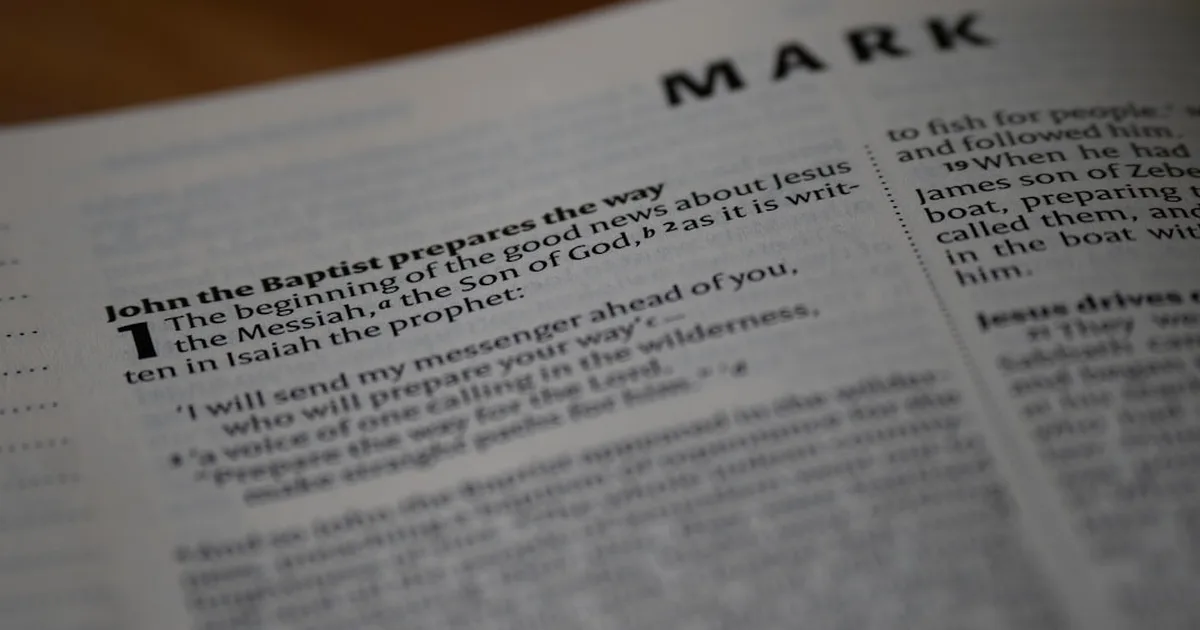
“The beginning of the good news about Jesus the Messiah, the Son of God.” (Mark 1:1, NIV)
Missionary Companion and Reconciliation
In addition to his closeness to Peter, Mark also collaborated with his cousin Barnabas and with Paul on missionary journeys. Together they set out for Antioch and Cyprus, bringing the message of salvation to the Gentiles. However, on one of those trips, Mark decided to return to Jerusalem, which caused a rift with Paul. Later, they reconciled, and Paul himself acknowledged Mark's value in his letters: “Get Mark and bring him with you, because he is helpful to me in my ministry” (2 Timothy 4:11, NIV). This story teaches us that conflicts can be overcome and that God always gives second chances.
Mark also accompanied Peter in Rome, where he likely wrote his Gospel for a persecuted Christian community. His message was clear: Jesus is the Son of God who came to serve and to give his life as a ransom for many. In the midst of suffering, the early Christians found comfort knowing that their Master had faced the cross and had overcome.
Mark's Legacy in Alexandria
Tradition holds that Mark traveled to Egypt and founded the Church in Alexandria, becoming its first bishop. There he preached the gospel and performed miracles, but he also faced opposition from pagan authorities. Finally, he was martyred around AD 68, tied to a rope and dragged through the streets of the city. His death was not in vain; the seed he planted bore fruit, and Alexandria became one of the most important centers of ancient Christianity.
Today, Saint Mark is venerated as the patron saint of Venice, where his relics rest in the majestic St. Mark's Basilica. He is also the patron saint of scribes, notaries, and lawyers, perhaps because of his work as an evangelist and chronicler.
Lessons for Our Faith Life
The story of Saint Mark invites us to reflect on our own calling. Just as he put his pen at the service of the gospel, we can use our talents for





Comments