
In the current debate on artificial intelligence, we often focus on ethical and regulatory aspects. It is right and necessary to establish rules to protect human dignity, but there is a question that precedes all others: what does it truly mean to be human? This is not an abstract issue, but the foundation on which to build every reflection. If we are not clear about our identity, every ethical limit risks seeming arbitrary, and every freedom, without boundaries, can become dangerous.
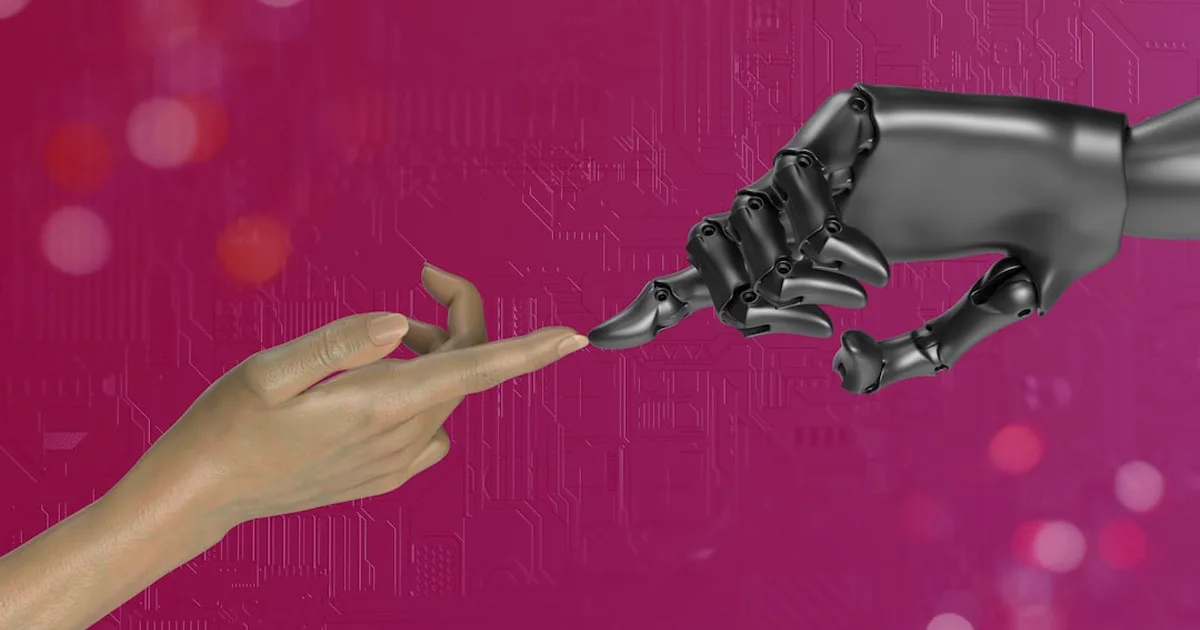
The greatest challenge posed by AI is not technical or legal: it is anthropological. What makes the human being irreducible to a machine, no matter how sophisticated? Is there something in us that no algorithm can ever replicate? To answer, we must look to the Christian tradition, which offers a profound and often overlooked vision.
Humanity as the Image of God: A Revolutionary Truth
The Bible tells us that man was created in the image and likeness of God (Genesis 1:26-27). This statement is not a mere religious formula, but a truth that changes everything. It means that our value does not derive from what we do or produce, but from what we are: creatures loved by God, called to a relationship with Him and with others.
Being the image of God implies an ontological participation in the divine life. We are not merely functional beings, but persons with intrinsic dignity. As the psalmist writes: "What is man that you are mindful of him? [...] You have made him a little lower than the angels and crowned him with glory and honor" (Psalm 8:4-5). This vision protects us from the temptation to reduce ourselves to mere cogs in a system, measuring our worth by efficiency or productivity.
Conscience and the Heart: Beyond Data Processing
Artificial intelligence can process data, recognize patterns, and make decisions based on algorithms. But it lacks something essential: consciousness, the capacity to love, to suffer, to hope. Man is not just a brain processing information, but a heart seeking meaning. Scripture reminds us that "the purposes of the human heart are deep waters" (Proverbs 20:5), a dimension that no machine can explore.
Jesus himself taught us that the greatest commandment is to love God and neighbor (Matthew 22:37-39). Love is not an algorithm, but a free and personal choice. It is in relationship, in self-giving, that man fully realizes his humanity. As Paul said: "If I speak in the tongues of men and of angels, but have not love, I am a noisy gong or a clanging cymbal" (1 Corinthians 13:1).
The Risk of a Reductionist View of Humanity
When we forget our identity as creatures made in the image of God, we fall into the trap of considering ourselves merely as more complex machines. This mindset opens the door to dangerous paths: why not enhance humans with technology until they become cyborgs? Why not transfer consciousness to a digital medium? If man is just a set of functions, it seems logical to improve them without limits.
But the Christian faith offers a different perspective. Man is not a project to be optimized, but a mystery to be respected. Our body is not a shell, but an integral part of our identity. As Psalm 139:14 says: "I praise you because I am fearfully and wonderfully made; your works are wonderful." Technology can be a tool, but it must never become the measure of our humanity.
An Ethics Grounded in Christian Anthropology
To face the challenges of AI, we need an ethics that is not merely procedural, but rooted in a solid anthropology. Rules are important, but they are not enough alone. We must rediscover who we are: creatures loved by God, called to communion with Him and with our brothers and sisters. Only then can we





Comments