
In the heart of Santa Fe, New Mexico, stands a small chapel that holds one of the greatest enigmas of modern Christian faith. The Loretto Chapel, built in the late 19th century, is famous not only for its Gothic Revival architecture but for a staircase that seems to defy the laws of nature. Each year, thousands of pilgrims come to marvel at what many call "the miraculous staircase." What makes it so special? Read on to discover its story.
The Chapel's Story and the Need for a Staircase
The story begins in 1873, when the Sisters of Charity of Our Lady of Light commissioned the construction of a chapel dedicated to Our Lady of Light. The architect, a Frenchman named Antoine Mouly, designed a beautiful building but with a problem: the choir loft, located on the upper floor, had no direct access from the ground floor. The sisters needed a staircase that would allow the nuns to reach the choir, but the space was very limited. Local carpenters said it was impossible to build a staircase that would fit in that spot without taking up too much room.
The Arrival of a Mysterious Carpenter
Desperate, the sisters began to pray to Saint Joseph, the carpenter saint, asking for his intercession. Tradition says that one day a humble man appeared with a donkey loaded with tools. He offered to build the staircase but asked to work alone, locked inside the chapel. The sisters agreed, and for several months they heard the sound of hammers and saws but never saw the man. When he finished, he disappeared without asking for payment or leaving a trace. The staircase he left is the one we admire today.
The Three Unsolved Mysteries of the Staircase
The Loretto Chapel staircase is a marvel of carpentry and engineering, but it also holds three mysteries that to this day have no scientific explanation.
1. No Central Support
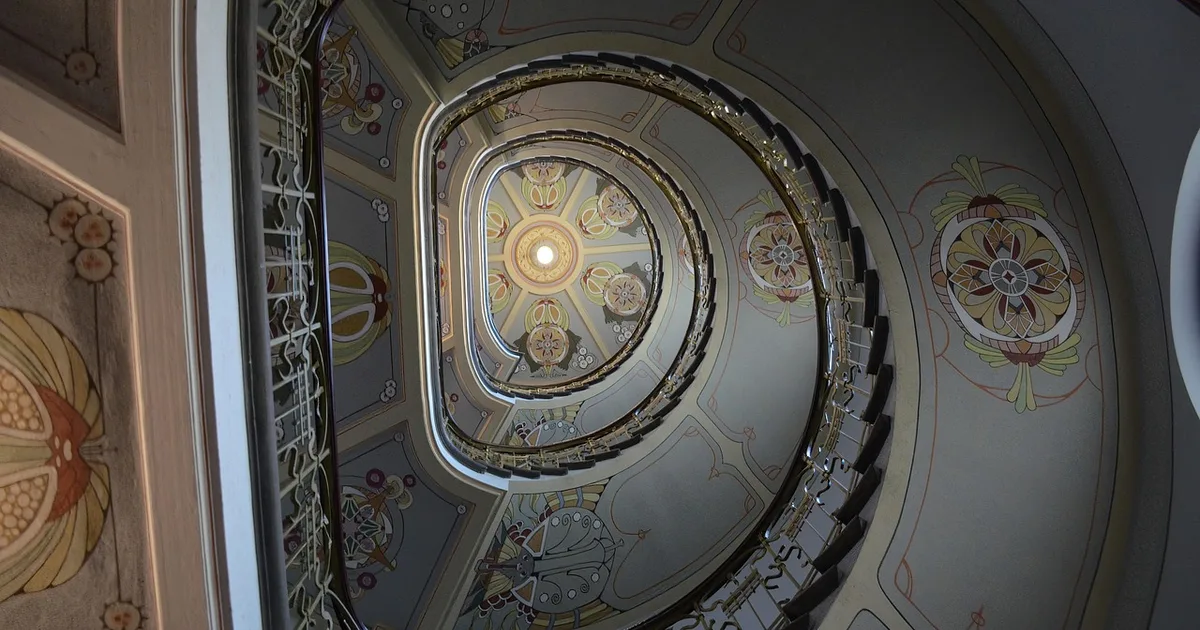
The staircase has two flights that turn 180 degrees, forming a spiral. What's astonishing is that it has no central support, like a pole or column. It is held up only by its own steps and the side wall. Carpentry experts have studied the staircase and cannot understand how it stays upright without a central support point. Moreover, the wood used is a species not native to the region: pine spruce, which is not found in New Mexico. Where did that wood come from?
2. No Visible Nails
If you look closely at the staircase, you'll notice there are no visible nails anywhere. Only wooden pegs were used to join the pieces. Modern carpenters have tried to replicate the staircase using the same techniques, but they have always had to use metal nails to give it stability. The original staircase, however, has withstood the passage of time and constant use without a single nail.
3. The Carpenter's Identity
No one knows who the man was who built the staircase. The sisters tried to find him after he finished, but they found no trace. They asked at local sawmills, but no one had seen a carpenter matching their description. Some believe it was Saint Joseph himself, answering the sisters' prayers. Others think it was an angel in disguise. What is certain is that the mystery remains unsolved.
What the Bible Says About Miracles and Faith
The story of the Loretto staircase reminds us that God works in mysterious ways. In the Bible, we find numerous examples of divine interventions that defy human logic. For instance, in the book of Acts, Peter is freed from prison by an angel (Acts 12:6-10). Or in the Old Testament, the prophet Elijah is fed by ravens (1 Kings 17:2-6). These stories encourage us to trust in God's power, even when circumstances seem impossible. The Loretto staircase stands as a tangible reminder that faith can move mountains—or build a staircase without nails or central support.





Comments