
When we think of Rome, our minds immediately go to its imposing monuments, its millennial history, its role as the cradle of Western civilization. But there is a lesser-known side, a shadow that stretches over its ancient streets and deserves to be explored with fresh eyes. Today, as Christians, we can look at this legacy not only with admiration but also with a critical spirit, seeking to draw lessons for our faith and daily life.
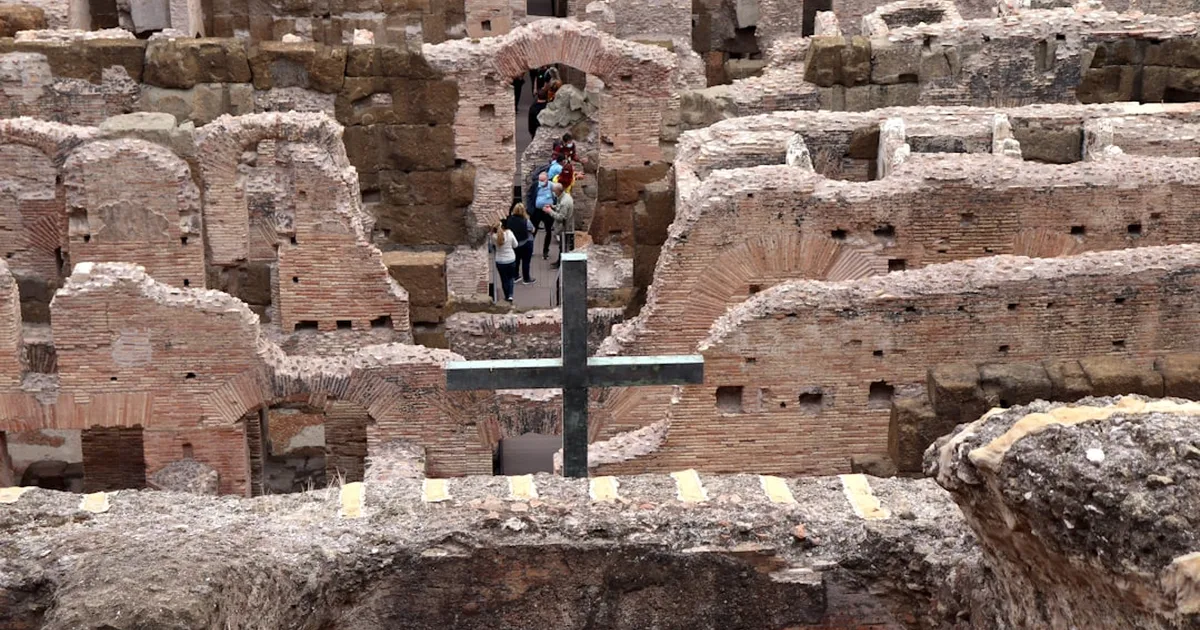
Imperial Rome, with its power and culture, represented an enormous challenge for the early Christians. On one hand, the city was a melting pot of peoples and ideas, a place where the Gospel could spread rapidly thanks to communication routes and a common language. On the other, it was also the center of a political and religious system that often directly opposed the message of Christ. The persecutions, the martyrs, the trials: all of this is part of a history that should not be forgotten.
Today, centuries later, we can ask ourselves: what does this history tell us? How can we, as 21st-century Christians, read the shadows of ancient Rome to better understand our faith and our engagement in the world? The answer is not simple, but it is worth exploring.
Earthly Power and the Sovereignty of God
One of the most fascinating and controversial aspects of ancient Rome is its concept of power. The emperor was considered a god, the pontifex maximus, the lord of life and death. For Christians, this was a direct challenge to their faith in one God and Lord, Jesus Christ. As the apostle Paul writes in his letter to the Romans, "There is no authority except that which God has established" (Romans 13:1), but this does not mean passively accepting every form of power.
The early Christians had to learn to distinguish between respect for civil authority and the worship due only to God. They paid for this distinction with their blood, but they left a precious legacy: the awareness that human power is always limited and subject to God's judgment. In an age like ours, where political, economic, and media power often seems absolute, this lesson is more relevant than ever.
The book of Revelation, with its description of "Babylon the Great," offers a prophetic critique of every system of power that sets itself against God. It is not a rejection of the world, but an invitation not to conform to its values when they conflict with the Gospel. As Christians, we are called to be "the salt of the earth" and "the light of the world" (Matthew 5:13-14), not to hide or flee.
The Search for Truth in a World of Deception
Ancient Rome was also a place of great intellectual and religious ferment. Philosophers, poets, rhetoricians: all sought to make sense of life and the cosmos. But alongside this quest, there were also superstitions, mystery cults, and widespread skepticism. Christians found themselves navigating this sea of ideas, bringing a message of truth that was not the result of human speculation but of divine revelation.
Today, the cultural landscape is not much different. We live in an age of information, but also of disinformation, fake news, and relativism. The temptation to adapt faith to the fashions of the moment is strong. Yet Scripture reminds us: "You will know the truth, and the truth will set you free" (John 8:32). Not an abstract truth, but a person: Jesus Christ, who is "the way and the truth and the life" (John 14:6).
The history of the early Christians in Rome teaches us that truth is not imposed by force, but witnessed through life. In a world that often prefers half-truths or comfortable lies, we are called to be witnesses of the truth, even at the cost of going against the tide. As Tertullian, one of the early Christian theologians, wrote: "The blood of the martyrs is the seed of new Christians."





Comments