
Catedral Metropolitana de la Ciudad de México

General Information
Denomination
Catholic
Address
P.za de la Constitución S/N Col. Centro
Cuauhtemoc, Ciudad de México, México
C.P. 6000
Location
Find the approximate location of Catedral Metropolitana de la Ciudad de México
Location data: © OpenStreetMap contributors via LocationIQ | Visualization: Google Maps
How to Get There
Address: P.za de la Constitución S/N Cuauhtemoc, Ciudad de México, México
About Catedral Metropolitana de la Ciudad de México
📜 History
The construction of this cathedral was ordered by King Felipe II of Spain through a royal decree in 1570, on the ceremonial center of the ancient Tenochtitlan. The works began in 1573 and lasted for approximately 240 years, formally concluding on August 15, 1813. Throughout that period, the project's direction passed through several architects: Claudio de Arciniega conceived the original design; José Damián Ortiz de Castro designed the bell towers before dying in 1793; and Manuel Tolsá, who arrived in 1791, completed the dome and the neoclassical facade. The building was dedicated on February 2, 1656 and consecrated on December 22, 1667. In its later history, episodes of national relevance are recorded: on July 21, 1822, the coronation of Agustín de Iturbide as the first emperor of Mexico was celebrated there; in 1825, the remains of Miguel Hidalgo and other heroes of the Independence were deposited in the precinct; and in 1864, the emperors Maximiliano and Carlota were received. On January 17, 1967, a fire caused considerable artistic losses, including damage to the two pipe organs, later restored. Between 1990 and 2000, a structural stabilization project was executed to correct the sinking caused by the instability of the lacustrine soil.
🏛️ Architecture
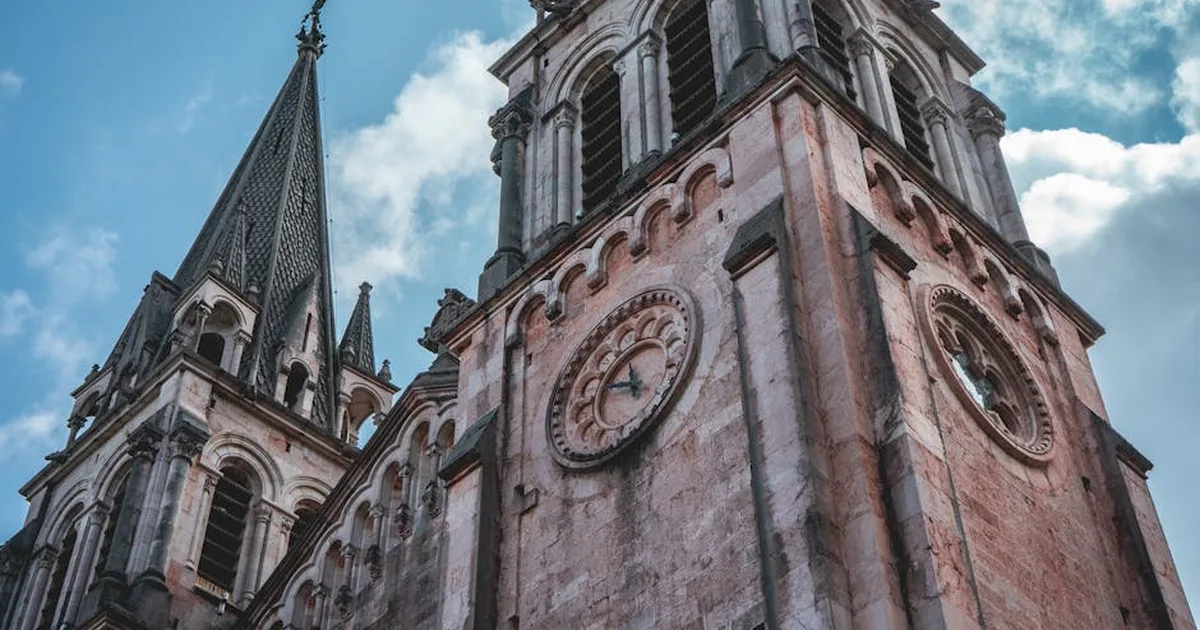
The building integrates several artistic styles accumulated during its almost three centuries of construction: Gothic, Plateresque, Baroque, Churrigueresque, and Neoclassical. Its floor plan is basilical with five naves, a transept, 51 vaults, 74 arches, and 40 columns; it measures 128 meters in length and 67 meters in width, with towers reaching 64 and 67 meters in height respectively. The foundation rests on approximately 20,000 wooden piles installed on lacustrine soil, a condition that also determined the north-south orientation of the building, unusual in cathedral architecture. The Neoclassical contribution of Manuel Tolsá includes the central dome with an octagonal drum, the finishing of the towers, and the sculptures of the three theological virtues—Faith, Hope, and Charity—that crown the facade. The interior houses the Altar of the Kings, a work by Jerónimo de Balbás completed in 1725, and the choir with 59 reliefs in mahogany and cedar; its bronze railing was manufactured in Macao in 1722 and installed in 1730. Two large 18th-century pipe organs, damaged in the 1967 fire and fully restored in 2014, complement the ensemble. Attached to the east side is the Sagrario Metropolitano, built between 1749 and 1768 according to the design of Lorenzo Rodríguez. The 16 side chapels and the 35 bells complete the ensemble.
⭐ Key Facts
The Metropolitan Cathedral is the seat of the Archdiocese of Mexico and the most important Catholic temple in the country. It is consecrated to the Assumption of the Virgin Mary and its patron saint is San Felipe de Jesús, the first Mexican martyr canonized. The precinct is part of the Historic Center of Mexico City, inscribed as a World Heritage Site by UNESCO in 1987, and is cataloged as a historical monument with classification 00206 by the National Institute of Anthropology and History. Throughout the centuries, it has been the setting for defining moments in national history: imperial coronations, state funerals, and visits by heads of government. On January 26, 1979, it received the first visit of Pope John Paul II to Mexico. In its crypts rest the remains of several archbishops of Mexico. The building was closed for worship during the Cristero War between 1926 and 1929, resuming ceremonies on June 21, 1929. The problems of differential sinking led to its inclusion on the list of the 100 most threatened sites of the World Monuments Fund, from which it was removed in 2000 after the conclusion of the stabilization project. Access is free and the precinct functions as an active place of worship and as a heritage site open to the public.
Located on the north side of the Plaza de la Constitución, this cathedral occupies the same space where ceremonies were held for centuries at the Aztec Templo Mayor. Walking through its five naves allows one to observe in a single building the evolution of New Spanish art and architecture through three centuries of history. Access is free and open every day, and masses are held at regular times. Those who visit Mexico City will find in this precinct a stone testimony of the different periods that shaped the nation's history.
✍️ Curated by Thomas Anderson
·
Last updated:
Information verified by the EncuentraIglesias editorial team
📚 Readings to strengthen your faith
Articles from the Faith & Life blog selected for this community



Did you notice something incorrect?😯
We apologize 🙏. Being the most complete church directory in the world requires a lot of time and effort... and only God is perfect 😄! We would greatly appreciate it if you help us with your suggestions to keep the information verified and reliable.
You can send us your observations, suggest corrections or even request that we remove this record if you consider it does not correspond to a church.
Suggest an edit