
Catedral de Santiago de Compostela

General Information
Denomination
Catholic
Address
Praza do Obradoiro
Santiago de Compostela, A Coruña, España
C.P. 15705
Location
Find the approximate location of Catedral de Santiago de Compostela
Location data: © OpenStreetMap contributors via LocationIQ | Visualization: Google Maps
How to Get There
Address: Praza do Obradoiro Santiago de Compostela, A Coruña, España
About Catedral de Santiago de Compostela
📜 History
The Cathedral of Santiago de Compostela has its origins in the year 813, when the hermit Pelayo discovered what was considered the tomb of the apostle Saint James the Greater. King Alfonso II ordered the construction of a first church on that site. In 899, Alfonso III erected a new pre-Romanesque basilica that was destroyed in 997 during the raid of Almanzor, although the tomb was respected. The construction of the current building began in 1075 under the reign of Alfonso VI and Bishop Diego Peláez, with the master builders Bernardo el Viejo, Galperino Roberto, and Maestro Esteban. Starting in 1168, Maestro Mateo assumed the direction of the works. In 1120, Pope Calixto II elevated the see to archiepiscopal rank. The Pórtico de la Gloria was completed in 1188, and the complex was definitively consecrated in April 1211. Throughout the following centuries, Gothic and Baroque elements were added; the Obradoiro façade was completed in 1740 by Fernando de Casas Novoa. The apostolic relics, rediscovered in 1879, were authenticated by Pope Leo XIII in 1884.
🏛️ Architecture
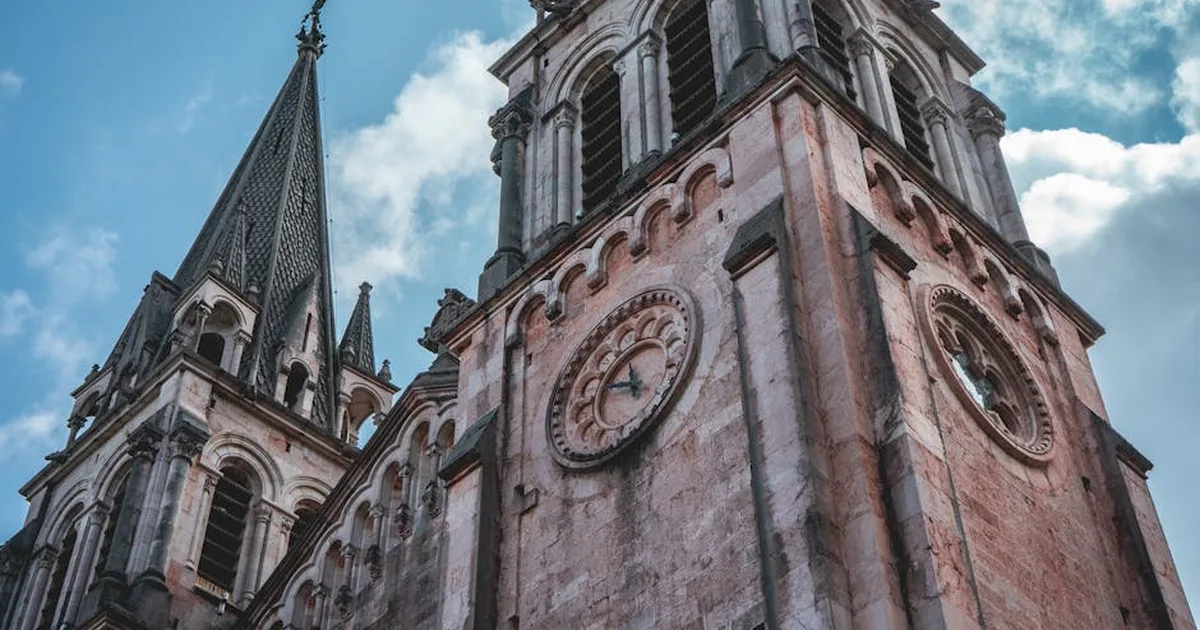
The temple corresponds to a Latin cross plan with three naves, a wide transept, and an ambulatory with five radial chapels, built entirely in granite. It measures approximately 97 meters in length, 22 meters in height in the central nave, and 70 meters in width at the transept; its total area is around 8,000 square meters with a capacity for 1,500 people. The central nave features a barrel vault characteristic of the Romanesque style, while the ambulatory allows the circulation of pilgrims around the main altar. The Pórtico de la Gloria, the work of Maestro Mateo completed in 1188, is the western access to the temple: its three arches show a central tympanum with Christ Pantocrator surrounded by the four Evangelists and a central column with the figure of the apostle Saint James. The Obradoiro façade, completed in 1740 by Fernando de Casas Novoa, corresponds to the Baroque style of the 18th century. The Azabachería façade, to the north, was finished in 1769 combining Baroque and Neoclassical elements. Inside, the botafumeiro stands out, a censer 1.6 meters high and weighing 80 kilograms, crafted in 1851 by the silversmith José Losada.
⭐ Key Facts
The sanctuary is the final destination of the Camino de Santiago, one of the most widespread pilgrimage routes in the Christian world since the Middle Ages, and houses the relics of the apostle Saint James the Greater in the crypt beneath the main altar. Pope Calixto II established in 1122 the privilege of the Compostelan Holy Year, confirmed by Pope Alexander III in 1179: when July 25th—the feast day of the Apostle—falls on a Sunday, the Holy Door is opened and pilgrims who pass through it obtain a plenary indulgence. Those who travel at least 100 kilometers on foot or 200 by bicycle receive the Compostela, a certificate that accredits their arrival. The historic center of Santiago de Compostela, with the cathedral as its nucleus, was inscribed on the UNESCO World Heritage List in 1985, and the temple has had an individual inscription since 2015. The relics preserved in the crypt were authenticated by Pope Leo XIII in 1884, reinforcing the link between the ecclesiastical institution and Jacobean devotion. The temple is also the seat of the Archdiocese of Santiago de Compostela.
Those who arrive in Santiago de Compostela at the end of the Camino find in this temple the point of confluence of centuries of devotion and thousands of kilometers of route. The crypt guards the relics of the apostle, the Pórtico de la Gloria exhibits a 12th-century Romanesque sculptural program in stone, and the botafumeiro marks with its ritual the most solemn liturgies. Every July 25th, the feast of Saint James turns the Obradoiro square into the stage of a celebration that brings together pilgrims and faithful from numerous countries.
✍️ Curated by Benjamín Restrepo
·
Last updated:
Information verified by the EncuentraIglesias editorial team
📚 Readings to strengthen your faith
Articles from the Faith & Life blog selected for this community



Did you notice something incorrect?😯
We apologize 🙏. Being the most complete church directory in the world requires a lot of time and effort... and only God is perfect 😄! We would greatly appreciate it if you help us with your suggestions to keep the information verified and reliable.
You can send us your observations, suggest corrections or even request that we remove this record if you consider it does not correspond to a church.
Suggest an edit