
Basilique Notre-Dame de Fourvière
.jpg?width=1200)
General Information
Denomination
Catholic
Address
Chemin du Rosaire Col. Lyon 5e Arrondissement
Lyon, Auvergne-Rhône-Alpes, Francia
C.P. 69005
Location
Find the approximate location of Basilique Notre-Dame de Fourvière
Location data: © OpenStreetMap contributors via LocationIQ | Visualization: Google Maps
How to Get There
Address: Chemin du Rosaire Lyon, Auvergne-Rhône-Alpes, Francia
About Basilique Notre-Dame de Fourvière
📜 History
The Basilica of Notre-Dame de Fourvière rises on the hill of the same name in Lyon, France, on a site with deep religious history. Marian devotion at this location dates back to the 17th century: in 1643, during an outbreak of bubonic plague, the inhabitants of Lyon made a vow to the Virgin Mary, an event that consolidated the tradition of pilgrimage to the hill of Fourvière. In 1832, the city attributed its protection against cholera to the same intercession. When the Franco-Prussian War threatened France in 1870, the Lyon community renewed its vows and committed to building a new basilica on the site. The cornerstone was laid in 1872 under the direction of architect Pierre Bossan, who conceived a design combining Romanesque, Gothic, and Neo-Byzantine elements. Upon his death, the project was continued by Louis Sainte-Marie Perrin. The main structure was completed in 1884, although interior ornamentation work continued until 1964. The building was financed entirely with private funds, reflecting the deep-rooted Marian devotion among the population of Lyon.
🏛️ Architecture
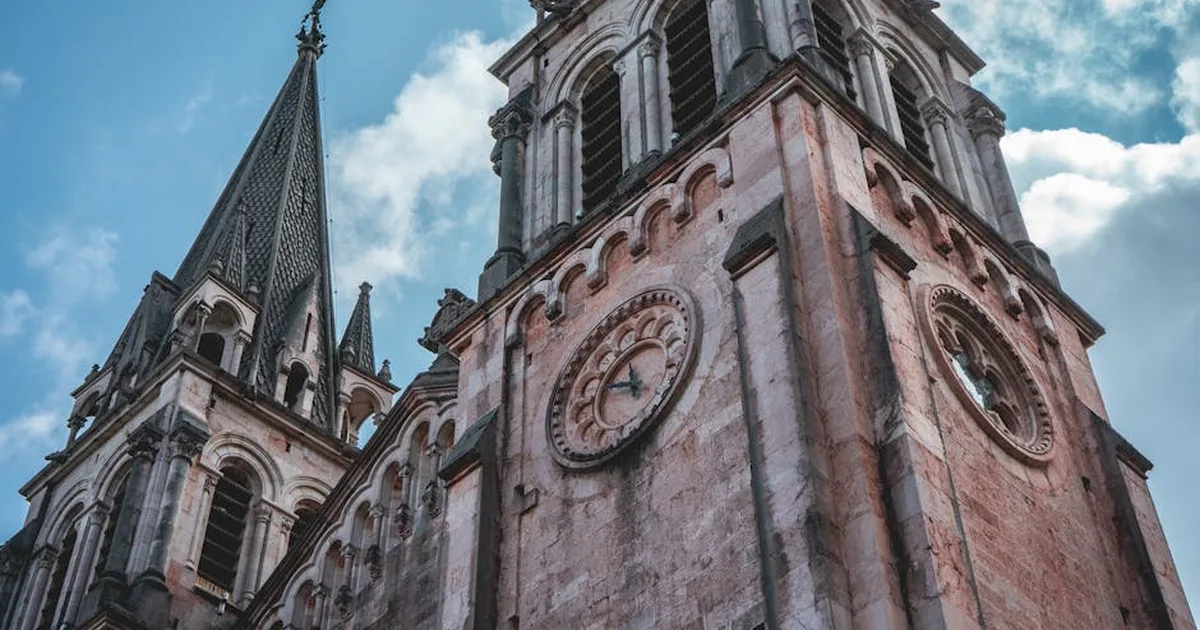
The temple combines three historical styles: medieval-influenced Romanesque, Gothic, and Neo-Byzantine, an unconventional choice for its time of construction. Designed by Pierre Bossan and completed by Louis Sainte-Marie Perrin, the basilica measures 86 meters in length and 35 meters in width; its four main towers reach 48 meters in height, and the complex incorporates three domes. At the top of the bell tower stands a gilded statue of the Virgin Mary, visible from extensive areas of the city. The materials used include white marble, blue marble, pink granite, and green onyx, giving the building a varied color palette. The interior is distributed across two levels: the upper church is profusely decorated with mosaics and stained glass covering extensive surfaces of walls and vaults, while the lower church, the Crypt of Saint Joseph, features a more sober finish. The inhabitants of Lyon colloquially refer to the building as 'the upside-down elephant,' alluding to the silhouette formed by the towers when the basilica is viewed from certain angles in the city.
⭐ Key Facts
The Basilica of Notre-Dame de Fourvière occupies a central place in the religious and cultural identity of Lyon. As part of the city's historic site, it was included on the UNESCO World Heritage List in 1998, a recognition that encompasses the historic urban ensemble of Lyon. In 2014, the French state declared it a historic monument. The temple receives approximately two million visitors per year, a figure that makes it one of the most frequented religious sites in France. It houses a Museum of Sacred Art containing pieces related to the history of the building and Marian devotion in the region. The hill of Fourvière, where the basilica is located, offers panoramic views over the urban ensemble of Lyon and the confluence of the Rhône and Saône rivers, making it a landmark of both landscape and spiritual significance. The main dedication is to Our Lady of Fourvière, and the building functions both as a site of Marian pilgrimage and a destination for cultural tourism for visitors from around the world.
Those who visit Lyon will find in the Basilica of Fourvière a site that concentrates centuries of religious history, mosaics of notable artistic craftsmanship, and a privileged position overlooking the city. Access to the hill can be made on foot or by funicular, and the tour of the interior—from the Crypt of Saint Joseph to the upper naves covered in mosaics—offers a valuable experience both for those seeking a space for spiritual reflection and for those interested in European architectural heritage.
✍️ Curated by María del Carmen Salazar
·
Last updated:
Information verified by the EncuentraIglesias editorial team
📚 Readings to strengthen your faith
Articles from the Faith & Life blog selected for this community



Did you notice something incorrect?😯
We apologize 🙏. Being the most complete church directory in the world requires a lot of time and effort... and only God is perfect 😄! We would greatly appreciate it if you help us with your suggestions to keep the information verified and reliable.
You can send us your observations, suggest corrections or even request that we remove this record if you consider it does not correspond to a church.
Suggest an edit